
NeuroDecode™ 2.0
Cognitive Decision-Support System
neurodecode.org
NeuroDecode™ is a cognitive decision support system.
It shows how emotional and relational complexity can be modelled as inputs, triggers, transitions, and system outputs.
↓

NeuroDecode™ is a cognitive regulation system designed for high-processing minds.
The product addresses a specific and underserved problem: the gap between knowing what to do and being able to do it under cognitive overload. Most productivity and wellness tools are built for calm users. NeuroDecode is built for the moment before calm is possible.
The system consists of three core mechanisms — Assist Run, Blueprint Diagnostic, and Manipulator OFF — supported by two persistent layers: Decision Anchor and History. Each mechanism operates on a different input type, a different cognitive state, and a different time horizon. The architecture enforces their separation because the separation itself is the cognitive contract of the system.
Every design decision was evaluated against a single question: what new information does this create for the user or the system? Elements that failed that test were removed — including screens, data points, and interaction states that took significant time to build.
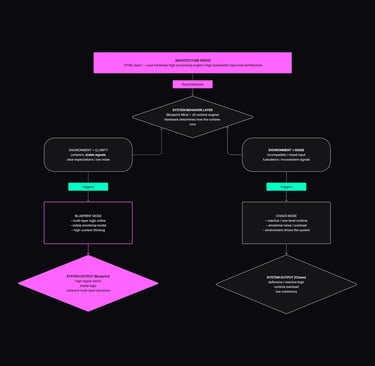
This model shows how user behaviour can be understood as a system interaction between cognitive architecture, environmental inputs, and behavioural outcomes.
Instead of treating overload as a fixed personal trait, the model separates stable operating conditions from noisy or inconsistent input environments.
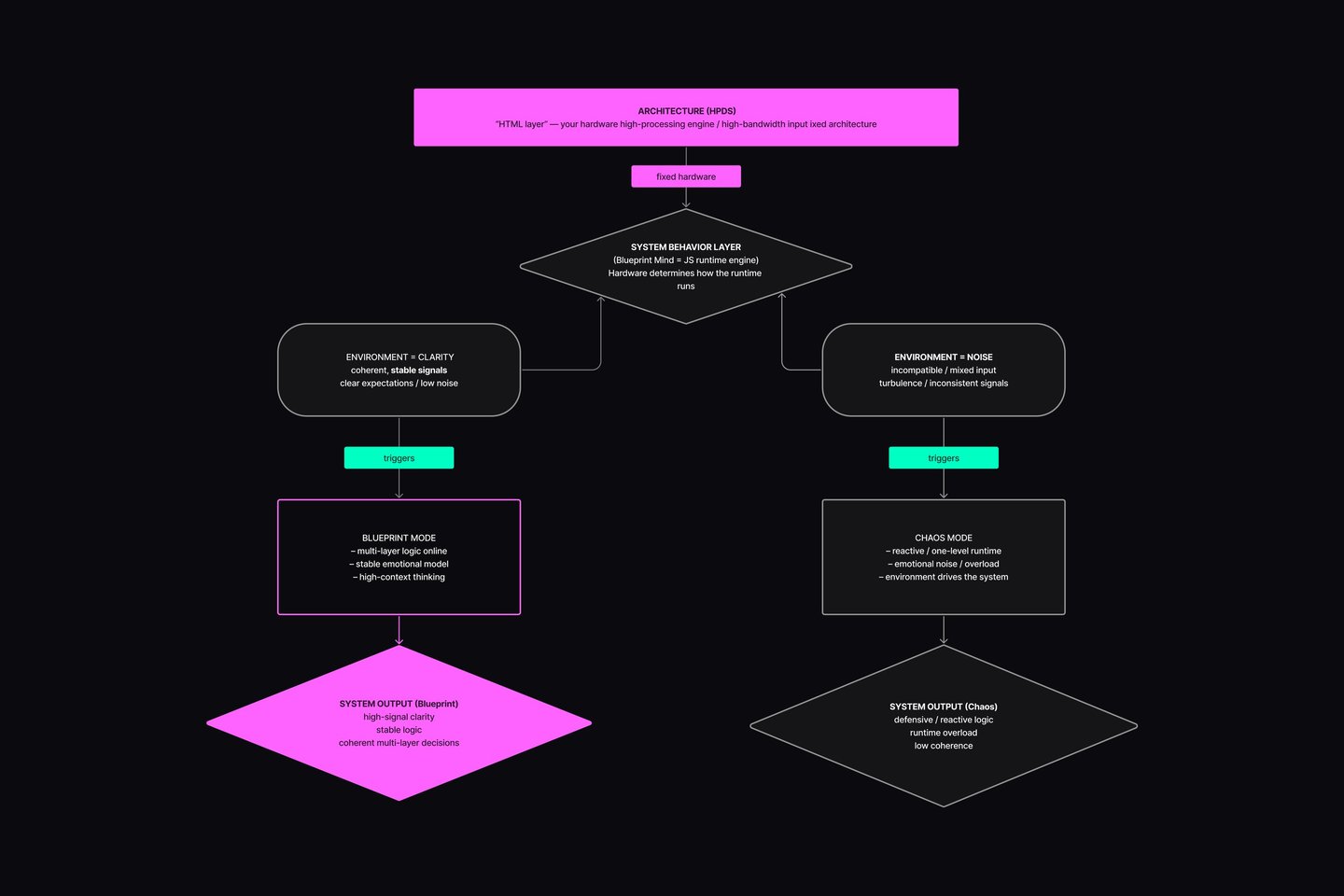

System Architecture
The solution was designed around three operational components:
Loop Detection & Closure
Signal Classification
Regulation Protocols
Each component addresses a different class of decision failure while preserving user agency and transparency.
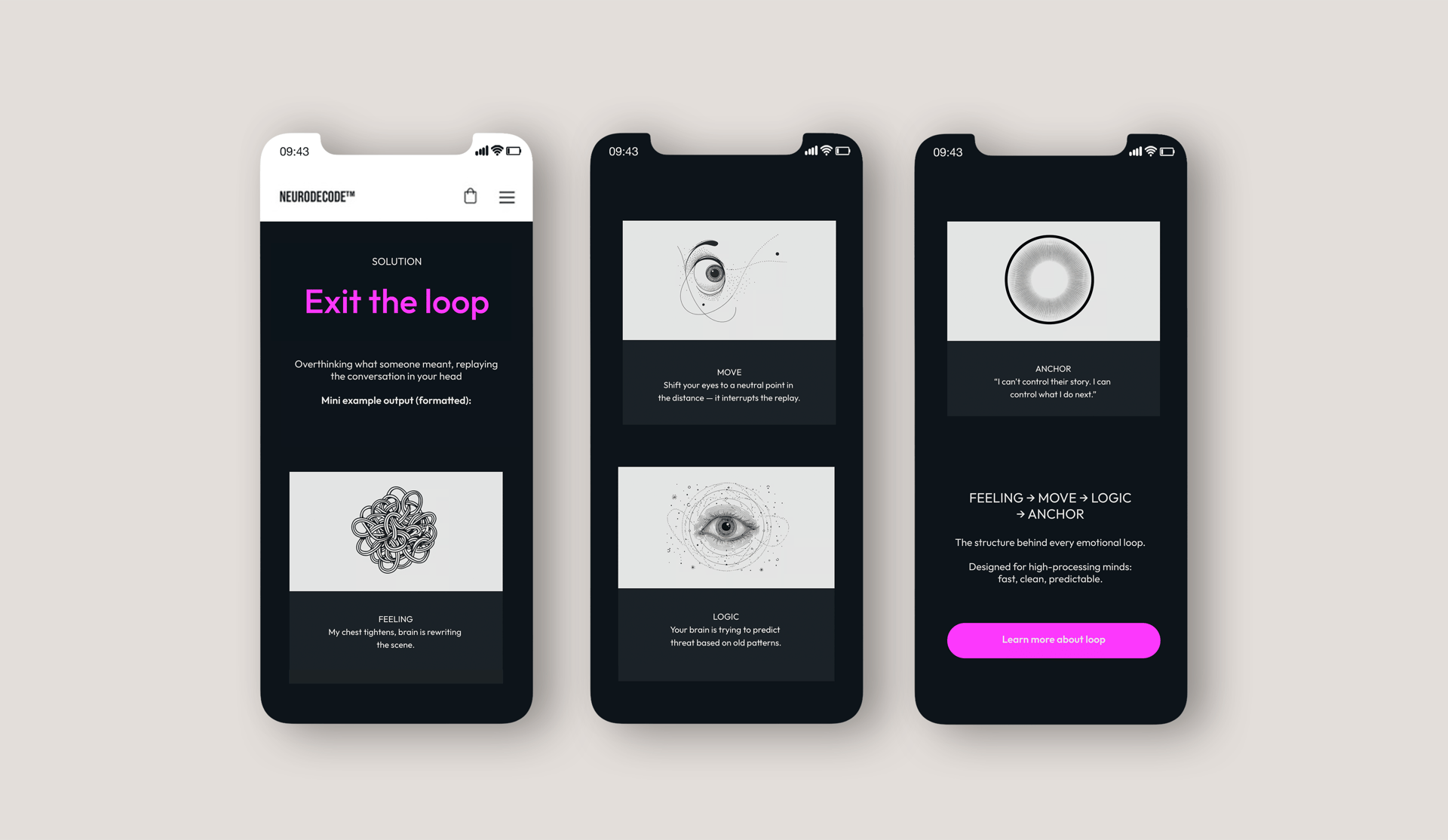
ND Engine — Interpretation layer
Loop Detection & Closure
Identifies when thinking or emotions are stuck in an open loop and provides structure to close it.


Blueprint vs Chaos Mapping
Distinguishes between coherent systems and noisy ones — in people, communication, or environments.
Shifts the system from overload to coherence without diagnosing or pathologising the user.
Regulation Protocols




Three mechanisms:
Output
— Coherence
The result is not insight for insight’s sake,
but functional clarity:
closed loops
reduced emotional noise
clear boundaries
stable, actionable decisions
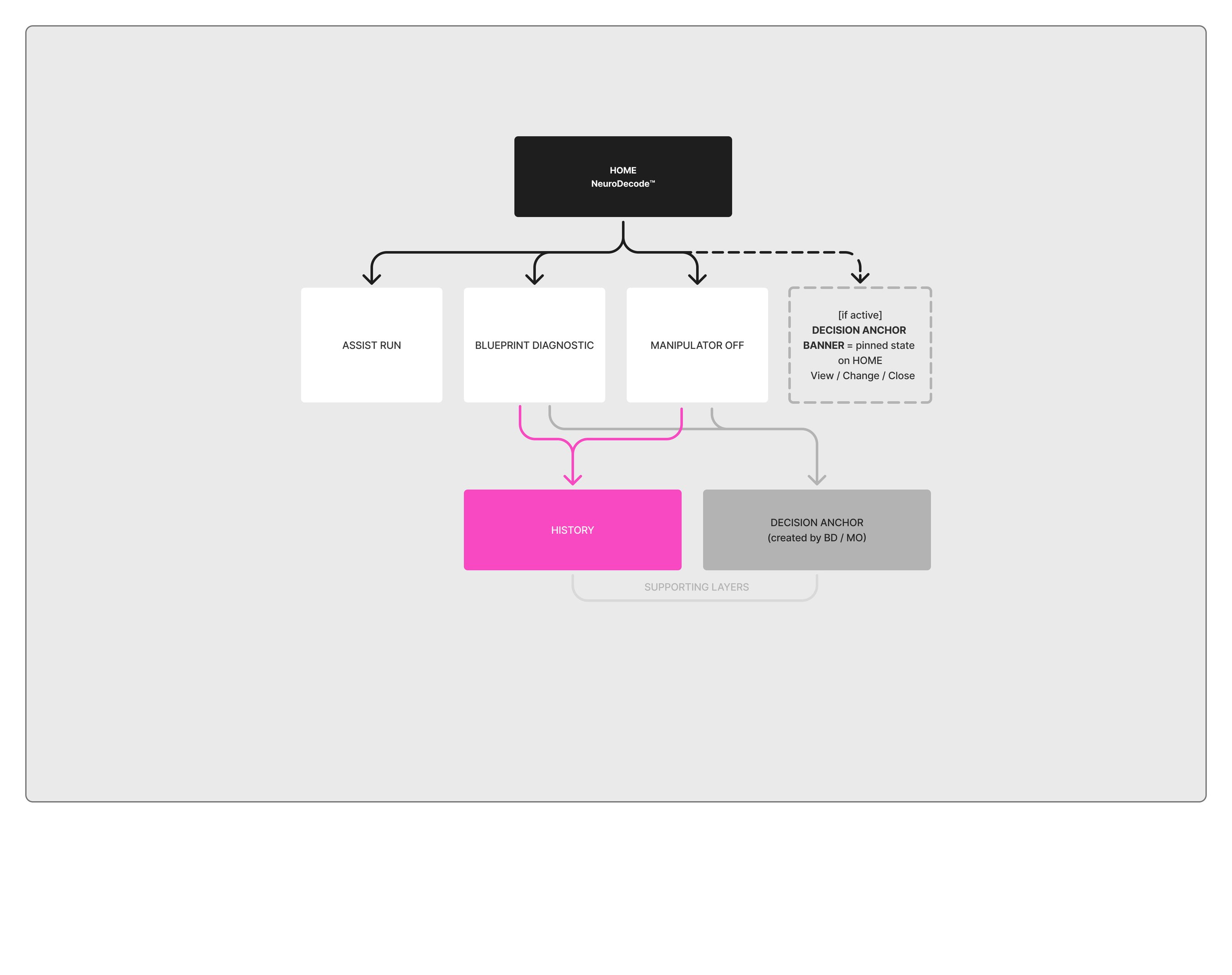
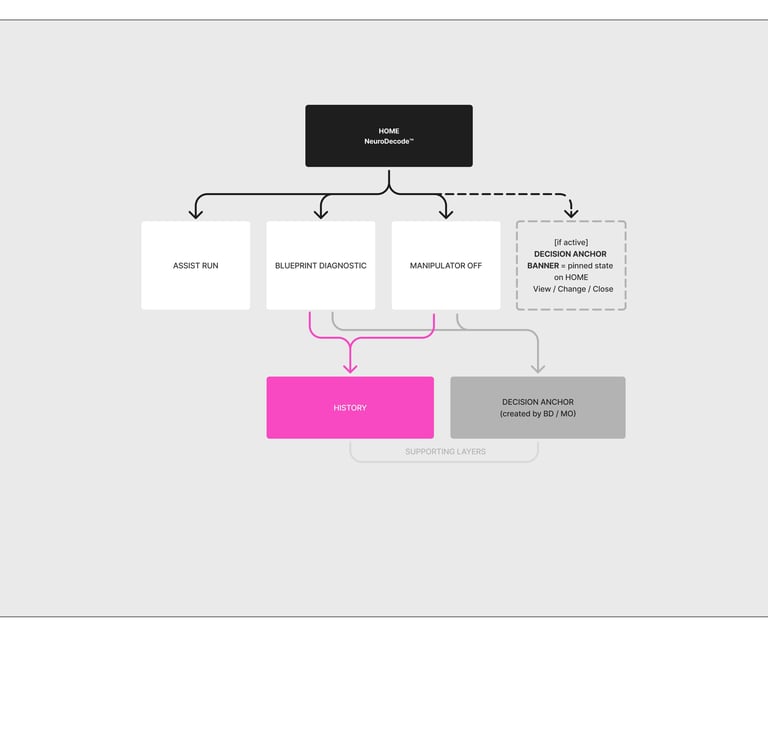
The conceptual model was translated into a modular application architecture.
The system is built around three core modules:
• Assist Run
• Blueprint Diagnostic
• Manipulator OFF
These modules address different categories of cognitive overload, interpretation risk, and decision friction.
Decision Anchor and History operate as supporting layers.
Decision Anchor provides a user-controlled pinned state that can be activated, viewed, modified, or dismissed whenever needed.
History allows users to review outputs generated by the Blueprint Diagnostic and Manipulator OFF modules, compare previous results, and make their own decisions based on the available information.
ND Application Architecture
The system does not evaluate users, prescribe actions, or determine what decisions should be made. Its role is limited to presenting structure, patterns, and observations while preserving user agency and decision ownership.
Application Flow Mapping
This Service Blueprint documents the ongoing translation of the application architecture into screen-level flows, module logic, and interaction rules.
The example below shows the Assist Run module, including state-based activity output, intensity mapping, user-facing rules, and cognitive ergonomics rationale.


Design Language
NeuroDecode uses a paper-warm background, black technical lines, and a single user-defined neon accent. Nothing else. The visual system follows the same rule as the product: every element that is present earns its place, and everything that does not carry information is removed. The result is an interface that reads as a working document — precise, load-bearing, and intentionally sparse. Bauhaus clarity, brutalist structure, Notion restraint.
Process
The architecture was locked before wireframes began. Wireframes were stress-tested before visual design started. Each phase produced decisions that fed forward — and occasionally required reversing decisions made in the phase before.
The process was designed to match the product: regulation before repair, clarity before aesthetics, one primary decision at a time.
HopeKiller Future Implementation
HopeKiller extends NeuroDecode from interpretation into environmental intervention. When a user deliberately decides not to monitor an unresolved event, the system temporarily protects that decision by reducing access to the trigger and monitoring for relevant change on the user’s behalf.
The behavioral mechanism is defined; the implementation layer remains intentionally open. Platform constraints — particularly on iOS — make this an engineering problem to solve rather than a predetermined technical solution.


Two lanes only: user action and system behavior. Technology / channel implementation intentionally left open.
NeuroDecode™ translates cognitive complexity into observable structures, states, and decisions.
Behind the Projects
Systems architecture, process models, decision frameworks, and system diagrams that shaped the final solutions.
Designing systems that remain usable under real human constraints.